Blackbird: Defeating PatchGuard, One Layer Deeper.
How do you maintain observability without sacrificing system stability? Diving into the depths of virtualization and extended page tables.
Read articleThere's a reason security products avoid kernel hooking. They are fragile, build-sensitive, and BSOD prone. Advanced malware analysis demands the visibility they provide. This post delves into the hook engine behind Blackbird and the struggle developing it.
How do you maintain observability without sacrificing system stability? Diving into the depths of virtualization and extended page tables.
Read articleA long Windows Active Directory chain from LDAP injection and NTLM coercion through delegated ACL abuse, AD CS ESC3, protected-object inheritance repair, and S4U2Self U2U with RBCD.
Read articleWhat happens when an EDR trusts filenames, unauthenticated localhost traffic and world-writable kernel objects? Five vulnerabilities, two SYSTEM LPE's and an RCE, a driver load and a lot of assumptions that should never have crossed a security boundary.
Read articleA complete Windows attack chain through OAuth account-linking abuse, stored browser navigation, SQLite extension loading, DPAPI credential recovery, and a writable SYSTEM service binary.
Read articleSysWhispers, HellsGate, HeavensGate, SidewaysGate, SpoofGate, TFGate, DoomGate, whatever gate your tool is being detected before the initial handle fully opens. How do EDR's detect & deny direct and indirect syscalls?
Read articleHow does Blackbird make Windows lie to malware's faces? Most anti-analysis checks trust the kernel because they have no choice. Blackbird weaponizes this by modifying syscall, timing & registry return data, erasing VM-identifiers and much, much more.
Read articleThere's a reason security products avoid kernel hooking. They are fragile, build-sensitive, and BSOD prone. Advanced malware analysis demands the visibility they provide. This post delves into the hook engine behind Blackbird and the struggle developing it.
Read articleModern defensive tooling doesn’t need to see payloads to stop you, it only needs to see the call path. This post breaks down how Windows system calls are intercepted, how syscall stubs became signatures, and why ActiveBreach takes a fundamentally different approach.
Read articleFair warning, this blogpost gets quite technical, goodluck!
Kernel hooking is not difficult because a jump is difficult, that's easy.
So why do EDR avoid kernel hooks? In itself they sound great, telemetry directly from the routines themselves, no callbacks required, full control over kernel components. It's not that easy.
Controlling all of the conditions around kernel routines well enough so that the target routine still behaves exactly as it did before is extremely difficult. That means respecting instruction boundaries, patchguard, register state, paged pools, IRQL constraints, memory protections, SMP visibility, handler lifetime, unload sequencing, performance and failure atomicity. Miss any one of those and bugcheck!
Sadly, EDRs also have to behave, since they are deployed on thousands, even millions of corporate and consumer systems. They can't afford to BSOD. Blackbird has no such problem;
This post covers the Blackbirds Kernel Hook Engine AKA the most challenging component I've ever built.
The paths under instrumentation are:
NtQuerySystemInformation(Ex)NtQueryInformationProcessNtWriteVirtualMemoryNtProtectVirtualMemoryNtCreateSectionNtMapViewOfSectionNtAllocateVirtualMemoryNtQuerySystemInformationExFlow:
Sounds simple right?
Blackbird needed lightweight telemetry on a narrow set of kernel-facing APIs that tend to matter for memory manipulation, section activity, and process inspection, I wanted this because Ob* & Ps* callbacks provide too little information.
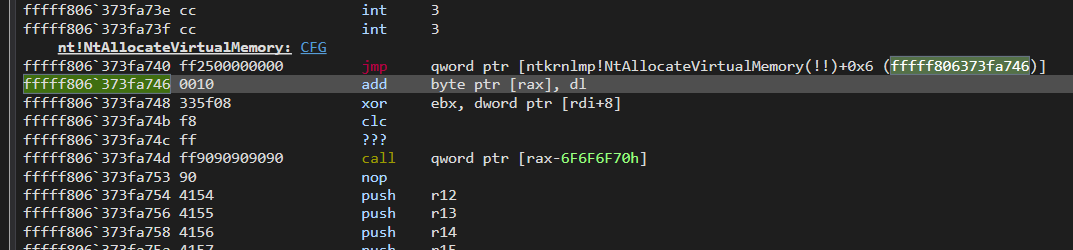
This, is the goal. That's a clean, working, hooked ntoskrnl.exe!NtAllocateVirtualMemory.
The original hook logic inherited too much user-mode thinking.
Usermode hooking is easy, especially NtXxx calls, as they all follow the same exact stub, with differing SSN's. Kernel? Not so much, did chatgpt just tell you to hook the SSDT? Bugcheck!
The assumptions were:
That includes:
This was NOT considered early on.
There were three real failure classes.
The first issue was boundary selection.
Some overwrite lengths cut through live instructions, which meant the trampoline replayed instruction fragments instead of complete instructions. Control flow then returned into a function that was already semantically poisoned.
First major lesson was that just because it covers the hook length doesn't mean it doesn't slice the kernel routine mid-instruction.
The logs that made this obvious were the live prologue dumps from install.
A one-byte miss was enough to Bugcheck!
This happened a lot.
The second issue was the hook encoding itself.
A mov rax, imm64; jmp rax style redirect is convenient, but it mutates RAX. That is not automatically safe just because it is common. A lot of targets care.
NtAllocateVirtualMemory was the clearest case. Early routine state was sensitive enough that clobbering RAX would destroy the kernel routine itself. The jump worked. The routine itself did not.
The third issue was failure handling.
One install failure path could leave the target routine patched while the trampoline state was already being torn down. That is a stale live entry point into freed executable memory, which is exactly the kind of bug that turns debugging into archaeology. Now if install fails, original bytes must be restored before anything else is released.
The engine is descriptor driven. Each hook target is described up front by BLACKBIRD_NTAPI_HOOK_DESCRIPTOR:
typedef struct _BLACKBIRD_NTAPI_HOOK_DESCRIPTOR
{
    PCSTR ApiName;
    PCWSTR Name0;
    PCWSTR Name1;
    PCWSTR Name2;
    PVOID HookFunction;
    ULONG OverwriteLength;
    BOOLEAN Required;
    ULONGLONG FallbackNtosOffset;
    UCHAR FallbackSignature[8];
    ULONG FallbackSignatureSize;
} BLACKBIRD_NTAPI_HOOK_DESCRIPTOR;
That descriptor specs:
Runtime state is stored in BLACKBIRD_NTAPI_HOOK:
typedef struct _BLACKBIRD_NTAPI_HOOK
{
    BLACKBIRD_NTAPI_HOOK_DESCRIPTOR Descriptor;
    PVOID RoutineAddress;
    PVOID Trampoline;
    UCHAR OriginalPatch[BLACKBIRD_NTAPI_MAX_OVERWRITE];
    BOOLEAN Installed;
} BLACKBIRD_NTAPI_HOOK;
Install begins by resolving the target export using MmGetSystemRoutineAddress, trying up to three names:
Hook->RoutineAddress =
    BLACKBIRDNtApiResolveAddress(
        Hook->Descriptor.Name0,
        Hook->Descriptor.Name1,
        Hook->Descriptor.Name2
    );
If export resolution misses, the engine can fall back to SSDT/signature-based resolution.
That fallback exists because MmGetSystemRoutineAddress ignores certain symbols.
if (!BLACKBIRDNtApiIsKernelPointer(Hook->RoutineAddress))
{
    return STATUS_PROCEDURE_NOT_FOUND;
}
Once the routine is resolved, the engine copies the original bytes from the target prologue into OriginalPatch:
RtlCopyMemory(Hook->OriginalPatch, Hook->RoutineAddress, overwriteLength);
Debug printing. Even in the kernel, I found myself spamming DbgPrintEx everywhere to see what WinDbg would pick up on, if you run Blackbird with a KdDebugger attached you'll see exactly what I mean.

The hook now uses a RIP-indirect absolute jump generated by BLACKBIRDNtApiBuildJump:
VOID BLACKBIRDNtApiBuildJump(UCHAR *Patch, PVOID Destination)
{
    ULONGLONG destination64;
    ULONG displacement = 0;

    destination64 = (ULONGLONG)(ULONG_PTR)Destination;
    Patch[0] = 0xFF;
    Patch[1] = 0x25;
    RtlCopyMemory(&Patch[2], &displacement, sizeof(displacement));
    RtlCopyMemory(&Patch[6], &destination64, sizeof(destination64));
}
Which produces:
FF 25 00 00 00 00
<8-byte absolute target>
Patch size is 14 bytes.
The hook no longer needs to burn a general-purpose register just to redirect control flow. No mov rax, imm64; jmp rax, which caused huge problems before. The patch bytes after the jump are padded with NOPs out to the validated overwrite length.
The trampoline is allocated from NonPagedPoolExecute and contains:
RoutineAddress + overwriteLengthBLACKBIRDNtApiHookInstall:
trampoline =
    ExAllocatePoolWithTag(
        NonPagedPoolExecute,
        overwriteLength + BLACKBIRD_NTAPI_PATCH_SIZE,
        BLACKBIRD_NTAPI_HOOK_TAG
    );

RtlCopyMemory(trampoline, Hook->OriginalPatch, overwriteLength);
BLACKBIRDNtApiBuildJump(
    trampolineJump,
    (PVOID)((PUCHAR)Hook->RoutineAddress + overwriteLength)
);
RtlCopyMemory(
    (PUCHAR)trampoline + overwriteLength,
    trampolineJump,
    BLACKBIRD_NTAPI_PATCH_SIZE
);
The trampoline is then stored as the "original" function pointer for that hook target. Every hook handler calls through that trampoline, not through some reconstructed fantasy of the original routine.
You may be wondering, how?
Yeah me too.
The engine remaps the target through an MDL and temporarily gives that mapping executable read-write protection.
What's an MDL?
An MDL (Memory Descriptor List) describes physical pages and allows the kernel to map them with different protections. Here it's used to temporarily create a writable mapping of normally read-only kernel code.
mdl = IoAllocateMdl(Destination, (ULONG)Size, FALSE, FALSE, NULL);
MmProbeAndLockPages(mdl, KernelMode, IoReadAccess);
mappedAddress = MmMapLockedPagesSpecifyCache(
    mdl,
    KernelMode,
    MmCached,
    NULL,
    FALSE,
    NormalPagePriority
);
MmProtectMdlSystemAddress(mdl, PAGE_EXECUTE_READWRITE);
Worth noting the cache type here: MmCached, not MmNonCached. I originally used MmNonCached and it caused problems. Creating overlapping UC and WB aliases to the same physical page is undefined behaviour per Intel Vol. 3A §11.12.4, and it means the write can bypass the L1/L2 cache entirely, leaving remote CPU icaches stale in a way that MFENCE alone can't fix. With MmCached the store goes through the normal WB cache hierarchy and the IPI-forced serialisation on each remote CPU is enough.
Then came another problem... Cores! Yes, the CPU ones. Turns out writing directly to kernel memory without any sort of synchronization causes problems. I've had to learn what IPI's are.
Basically, in usermode when you write to memory, the kernel memory handler will automatically do this for you, when working in kernel space it's on you. An IPI (Inter-Processor Interrupt) is exactly what it sounds like: an interrupt sent from one CPU to the others. It forces all processors to rendezvous so they can observe the same memory state before continuing execution. Without this, one CPU could execute invalid kernel memory, bugcheck!
KeIpiGenericCall(BLACKBIRDNtApiBroadcastWrite, (ULONG_PTR)&patchContext);
Inside the broadcast callback, one core performs the write while the rest rendezvous under the generic call mechanism:
if (InterlockedCompareExchange(&patchContext->Applied, 1, 0) == 0)
{
    // Commit bytes 1..Size-1 first, byte 0 last.
    // Byte 0 is 0xFF, the JMP opcode. Writing the tail first means any
    // concurrent observer reading the hook site before we're done still
    // sees the original byte 0, so the site stays in a valid pre-hook
    // state until the final store makes the jump live.
    for (i = 1; i < patchContext->Size; ++i)
    {
        patchContext->Destination[i] = patchContext->Source[i];
    }
    patchContext->Destination[0] = patchContext->Source[0];

    KeMemoryBarrier();
    {
        int cpuInfo[4];
        __cpuid(cpuInfo, 0);
    }
}
KeMemoryBarrier() issues an MFENCE but it isn't a serialising instruction, so it doesn't flush the instruction cache on remote processors. Self-modifying code on x86-64 needs a serialising instruction on the writing CPU after the stores complete. CPUID is the lightest one available in ring 0 on both Intel and AMD. The IPI delivery already forced a serialising interrupt on every remote CPU before they resumed, so the CPUID here only covers the writing core itself.
After the patch is applied, the engine immediately re-reads the modified bytes and compares them against the expected patch.
RtlCopyMemory(verifyPatch, Hook->RoutineAddress, overwriteLength);

if (RtlCompareMemory(verifyPatch, patch, overwriteLength) != overwriteLength)
{
    BLACKBIRDNtApiRollbackPatchOnInstallFailure(Hook, overwriteLength);
    return STATUS_DATA_ERROR;
}
If verification fails, rollback restores the original prologue bytes before anything else is freed:
rollbackStatus = BLACKBIRDNtApiWriteReadonlyMemory(
    Hook->RoutineAddress,
    Hook->OriginalPatch,
    OverwriteLength
);
Each hook follows the same broad structure:
For example, BLACKBIRDNtWriteVirtualMemoryHook:
BLACKBIRDNtApiHookEnter();

if (g_OriginalNtWriteVirtualMemory == NULL)
{
    status = STATUS_INVALID_DEVICE_STATE;
    goto Exit;
}

status = g_OriginalNtWriteVirtualMemory(
    ProcessHandle,
    BaseAddress,
    Buffer,
    BufferSize,
    NumberOfBytesWritten
);

if (!BLACKBIRDNtApiShouldLog(&callerPid))
{
    goto Exit;
}

observedWritten = BLACKBIRDNtApiReadSizeTSafe(NumberOfBytesWritten);
BLACKBIRDNtApiLog(
    "NtWriteVirtualMemory",
    callerPid,
    (UINT64)(ULONG_PTR)ProcessHandle,
    (UINT64)(ULONG_PTR)BaseAddress,
    (UINT64)(ULONG_PTR)Buffer,
    (UINT64)BufferSize,
    (UINT64)observedWritten,
    0, 0, 0,
    status
);
NtAllocateVirtualMemory Gets Special TreatmentNtAllocateVirtualMemory is not hooked through the same plain C path as the rest. The hook descriptor points to BLACKBIRDNtAllocateVirtualMemoryHookStub instead of a normal C handler.
NtAllocateVirtualMemory was one of the routines that proved especially sensitive to ABI and entry-state assumptions. Using a dedicated stub path reduces how much glue code gets to interfere with the call state before execution reaches the original trampoline.
There is also a pre-log path, BLACKBIRDNtAllocateVirtualMemoryPreLog, which records arguments only after the same gating logic is satisfied:
observedBase = BLACKBIRDNtApiReadPointerSafe(BaseAddress);
observedRegionSize = BLACKBIRDNtApiReadSizeTSafe(RegionSize);

BLACKBIRDNtApiLog(
    "NtAllocateVirtualMemory",
    callerPid,
    (UINT64)(ULONG_PTR)ProcessHandle,
    (UINT64)(ULONG_PTR)observedBase,
    (UINT64)observedRegionSize,
    (UINT64)ZeroBits,
    (UINT64)AllocationType,
    (UINT64)Protect,
    0, 0,
    STATUS_SUCCESS
);
Every hook entry increments g_NtApiHookInFlight:
VOID BLACKBIRDNtApiHookEnter(VOID)
{
    InterlockedIncrement(&g_NtApiHookInFlight);
}
Every exit decrements it and corrects underflow if anything goes wrong:
remaining = InterlockedDecrement(&g_NtApiHookInFlight);
if (remaining < 0)
{
    InterlockedExchange(&g_NtApiHookInFlight, 0);
}
During uninitialize, Blackbird does not immediately free trampolines. It first:
for (i = 0; i < BLACKBIRD_HOOK_COUNT; ++i)
{
    BLACKBIRDNtApiHookDeactivate(&g_Hooks[i]);
}

ExWaitForRundownProtectionRelease(&g_NtApiRundown);
BLACKBIRDNtApiWaitForInFlightCalls();

for (i = 0; i < BLACKBIRD_HOOK_COUNT; ++i)
{
    BLACKBIRDNtApiHookFreeTrampoline(&g_Hooks[i]);
}
Drivers have to be fast. Very fast. IRQL's must be cleared very quickly. If you've ever opened SystemInformer and watched the System Calls Delta stat you'll see that hundreds and thousands of syscalls execute every delta cycle. Now imagine a extra routine (a hook), on a lot of the core kernel functions, doing a bunch of processing and copying in that extremely critical path. Sounds slow right? It is.
I don't want to slow the system to a crawl, so I use a very simple state machine;
If the driver is not armed, the path exits quickly.
If the PID is not monitored, the path exits quickly.
If the current IRQL is wrong, the path exits quickly.
The hook engine still exists in the function entry path, but if the driver isnt armed, and if the PID the syscall is coming from isn't in the drivers armed list, it ignores it.
I see why people dislike kernel development. The amount of variables to constantly consider, reconsider and recheck again and again cause huge cognitive load. The debugging mechanisms being WinDbg, printing and analyze -v on bugchecks is extremely frustrating and causes slow debugging.
I also see how powerful it is, and why AntiCheats & EDRs live down here. There's a lot of misconcepts about Patchguard (KPP), people seem to think it protects the whole kernel, it does not. It is a telemetry goldmine, unfortunately any sophisticated EDR will make it almost impossible for userland malware to stay undetected, unless their heuristics are off. Not even getting started on the Hypervisors being brought in.
After spending significant time developing Blackbird to first of all detect my own frameworks, I realized what a large misconception a large part of the "maldev" community has surrounding EDRs. My project ActiveBreach is effective yes, until it faces a real EDR. That project is seen as "modern" and SysWhispers5 just released, still with the same misconcepts it had 5 years ago. Stackwalking and spoofing is one thing, but your allocations, threads, queries, handles, every single thing is monitored.