Blackbird: Defeating PatchGuard, One Layer Deeper.
How do you maintain observability without sacrificing system stability? Diving into the depths of virtualization and extended page tables.
Read articleModern defensive tooling doesn’t need to see payloads to stop you, it only needs to see the call path. This post breaks down how Windows system calls are intercepted, how syscall stubs became signatures, and why ActiveBreach takes a fundamentally different approach.
How do you maintain observability without sacrificing system stability? Diving into the depths of virtualization and extended page tables.
Read articleA long Windows Active Directory chain from LDAP injection and NTLM coercion through delegated ACL abuse, AD CS ESC3, protected-object inheritance repair, and S4U2Self U2U with RBCD.
Read articleWhat happens when an EDR trusts filenames, unauthenticated localhost traffic and world-writable kernel objects? Five vulnerabilities, two SYSTEM LPE's and an RCE, a driver load and a lot of assumptions that should never have crossed a security boundary.
Read articleA complete Windows attack chain through OAuth account-linking abuse, stored browser navigation, SQLite extension loading, DPAPI credential recovery, and a writable SYSTEM service binary.
Read articleSysWhispers, HellsGate, HeavensGate, SidewaysGate, SpoofGate, TFGate, DoomGate, whatever gate your tool is being detected before the initial handle fully opens. How do EDR's detect & deny direct and indirect syscalls?
Read articleHow does Blackbird make Windows lie to malware's faces? Most anti-analysis checks trust the kernel because they have no choice. Blackbird weaponizes this by modifying syscall, timing & registry return data, erasing VM-identifiers and much, much more.
Read articleThere's a reason security products avoid kernel hooking. They are fragile, build-sensitive, and BSOD prone. Advanced malware analysis demands the visibility they provide. This post delves into the hook engine behind Blackbird and the struggle developing it.
Read articleModern defensive tooling doesn’t need to see payloads to stop you, it only needs to see the call path. This post breaks down how Windows system calls are intercepted, how syscall stubs became signatures, and why ActiveBreach takes a fundamentally different approach.
Read articleWindows APIs route through multiple layers. Advanced defensive products intercept calls routing through these layers as part of their instrumentation. This is a problem for any red-team engagement and can end it before it even begins.
There wasn't a real framework that was maintainable, modular, configurable, secure, and easy to use; that gap gave me the idea for ActiveBreach, AKA ABE.
In this post, we'll dive into how I developed ABE and how Windows handles System Calls.
This article is about the Rust implementation of ActiveBreach Engine, which is currently the most mature and feature-complete version in the SDK.
ActiveBreach Engine project: github.com/8damon/ActiveBreach-Engine
The SDK also includes C and C++ variants, but the Rust version is the most advanced and actively developed, which is why it is the focus here.
Suppose you want to write memory to a remote process in a protected environment.
Unfortunately, your first detection happens before you even get to write any memory: the OpenProcess call.
The EDR sees an all-access handle opened to Chrome and can escalate or terminate the process before post-exploitation even starts.
Let's see what just happened under the hood.
HANDLE hProcess = OpenProcess(
    PROCESS_ALL_ACCESS, // accessRights
    FALSE, // inherited
    ProcessID // PID
);
We'll break on this call to observe it in disassembly.
HANDLE hProcess = OpenProcess(
mov         r8d,dword ptr [rbp+0A8h]
xor         edx,edx
mov         ecx,1FFFFFh ; PROCESS_ALL_ACCESS
call        qword ptr [__imp_OpenProcess] ; IAT
mov         qword ptr [hProcess],rax
We can see that OpenProcess calls __imp_OpenProcess; let's follow that.
Okay, now we're inside of KernelBase.dll!OpenProcess.
Why are we here? Well, when you include <Windows.h>, each API you use (in this case, OpenProcess) links to a system DLL. The Import Address Table (IAT) on process-load will then route your call to OpenProcess to KernelBase.dll!OpenProcess, (! signifies it is an exported entry)
Now KernelBase is going to add some extra attributes to your call before forwarding it to ntdll.dll, we don't care about this so I've excluded it.
mov         r11,rsp
sub         rsp,68h
xor         r9d,r9d
movsxd      rax,r8d
...
movdqu      xmmword ptr [rsp+50h],xmm0
call        qword ptr [__imp_NtOpenProcess] ; fwd to ntdll!NtOpenProcess
nop         dword ptr [rax+rax]
...
int         3
Now we're in hook land. In this example there's no hook; this is the generic Syscall Prologue/System Call Stub. The key part is the syscall instruction. On modern x64 Windows, syscall gateway stubs are primarily exposed through ntdll.dll (NT syscalls) and win32u.dll (Win32k/GDI/USER syscalls). In WOW64 processes, execution also transitions through wow64.dll, wow64win.dll, and wow64cpu.dll.
Any function that starts with Nt in the Windows API is part of the "Native API", which is largely undocumented and acts as the entry point to the kernel from user mode.
The point is that any function that ultimately executes kernel code has an underlying Nt function. In this case, OpenProcess requires the kernel, so it is routed down into NtOpenProcess.
mov         r10,rcx ; preserve RCX for return NTSTATUS
mov         eax,26h ; loads syscall number (26h) into EAX
test        byte ptr [7FFE0308h],1  ; check fallback bit (KUSER_SHARED_DATA+0x308)
jne         NtOpenProcess+15h
syscall     ; context-switch to kernel-mode
ret
int         2Eh ; uses this execution path if legacy
ret
Why not provide the Nt API upfront? Many Nt calls require extra parameters and undocumented structures that are automatically populated by higher-level routines (e.g., KernelBase.dll!OpenProcess populates the structures required by ntdll.dll!NtOpenProcess).
Now if you've been keeping up, you can see a perfect opportunity here for a defensive product (such as an EDR) to hook the Nt call instead of the higher-level API. There's more reason for this too: system call stubs all follow the exact same layout, so hooks do not need to be specialized for each function, and they're convenient and centralized.
This would be the most generic type of hook;
jmp     qword ptr [rip+EDR.dll+instrument_func]   ; jump to EDR instrument
nop ; no-op
nop
nop
nop
nop
I won't delve into the other hook variants here because they are outside the scope of this post; ABE's execution model is designed to avoid relying on those instrumented user-mode entry paths.
A System Call Stub (shown earlier) is the stub used by the operating system to execute a System Call, these calls are numbered by something called the System Service Number (SSN), with the SSN to a relevant syscall a user in theory can execute any System Call they want.
A Syscall stub can be created in your program with a function as simple as:
VOID* CREATE_SYSCALL_STUB(uint32_t SSN) {

    uint8_t stub[] = {
        0x4C, 0x8B, 0xD1,             // mov r10, rcx
        0xB8,                         // mov eax, imm32
        0x00, 0x00, 0x00, 0x00,       // SSN placeholder
        0x0F, 0x05,                   // syscall
        0xC3                          // ret
    };

    *(uint32_t*)(stub + 4) = SSN;

    VOID* mem = VirtualAlloc(
        NULL,
        sizeof(stub),
        MEM_COMMIT | MEM_RESERVE, PAGE_EXECUTE_READWRITE
    );

    if (!mem) return NULL;

    memcpy(mem, stub, sizeof(stub));

    DWORD old;

    VirtualProtect(mem, sizeof(stub), PAGE_EXECUTE_READ, &old);

    return mem;
}
This is what tools such as SysWhispers and Hell's Gate do, more specifically:
ntdll.dll.Syscall stubs are fragile by themselves. The syscall prologue is extremely unique, and the syscall instruction residing outside of ntdll.dll, especially within private memory, is a huge red flag for an EDR.
Soon defensive products integrated static scans into their smart screens that check for the syscall instruction and syscall prologues, detecting SysWhispers and similar tools alike. Defensive products also implemented runtime memory checks using similar rules for detecting syscall stubs in memory, leading to tools that dynamically generated stubs being suspected as well.
The simplest form of this rule can be broken down to:
if mov r10, rcx and syscall; ret appear in private memory, or if the memory region is not ntdll.dll: flag.
Or more literally:
rule Winx64_SYSCALL_STUB
{
    strings:
        $syscall_stub = {
            4C 8B D1            ; mov r10, rcx
            B8 ?? ?? ?? ??      ; mov eax, SSN
            0F 05               ; syscall
            C3                  ; ret
        }
}
Adversary tooling had to evolve. ABE therefore adopted a design model more commonly seen in anti-cheat and DRM systems, centered around stub encryption and build-time obfuscation.
Rather than embedding syscall prologues directly in the binary, ABE uses Rust build-time code generation to transform the syscall stub bytes before compilation. These bytes are encrypted during the build step and only materialized at runtime by the stub generation logic. As a result, the compiler never observes plaintext syscall opcodes, and no static artifacts are present on disk.
To address live memory inspection and heuristic scanning, generated stubs are encrypted again at runtime using a lightweight, custom LEA-based cipher. LEA was selected due to its simplicity, performance characteristics, and the absence of existing Rust implementations or mature detection heuristics. The implementation uses a reduced-round configuration, prioritizing low latency over cryptographic strength, sufficient to prevent opportunistic memory scanning without introducing measurable overhead.
note: ABE now uses AES-CTR, not LEA-128, same flow otherwise
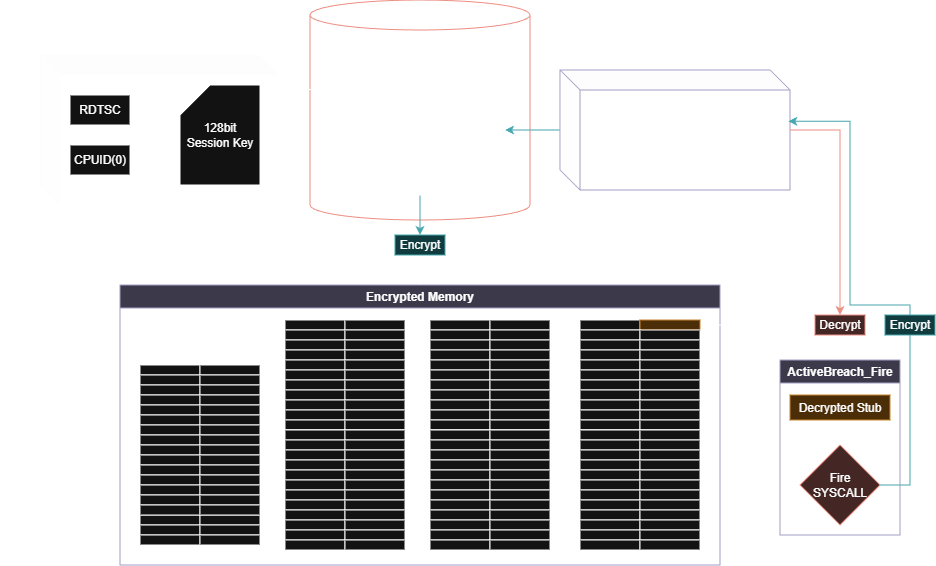
Recent versions of ABE expose three operational modes to support different deployment constraints:
Stealth
Leaves syscall stubs in RWX memory and avoids page protection transitions entirely, minimizing observable kernel interactions.
Secure
Actively transitions stub pages between NO_ACCESS and RWX using VirtualProtect, reducing exposure to external memory inspection at the cost of increased syscall activity.
NTDLL Backend
Switches dispatcher-model to a router to exported ntdll.dll!NtXxx functions with a verification system implemented to check & skip hooks that may be set on API's. This removes exposure to RWX stubs & syscalls originating from private executable memory. Also abides by RSP/RIP inside of ntdll.dll rules.
To control the execution environment, ABE uses a dedicated dispatcher thread which has full control over the stack.
A syscall execution engine is only as trustworthy as the metadata it relies on.
Many dynamic approaches resolve System Service Numbers (SSNs) by scanning the already-loaded ntdll.dll in memory. This works, but it assumes that the in-memory image has not been instrumented or modified. In environments where inline hooks are present, even reading stub bytes from the live module becomes unreliable.
ABE does not derive SSNs from the loaded module image.
Instead, it resolves the base of ntdll.dll using low-level memory inspection, recovers the backing file path via NtQueryVirtualMemory, and maps a clean copy of the on-disk image into private memory. The export table of this file-backed image is parsed manually, and only Nt* exports are considered. For each export, the stub prologue is inspected and the SSN is extracted directly from the expected mov eax, imm32 sequence.
This produces a syscall table derived from a disk-backed, uninstrumented image rather than a potentially modified in-memory view.
The resulting table is stored in a dedicated page and transitioned to READONLY once constructed. From that point forward, dispatch logic resolves SSNs exclusively from this internal table.
This design avoids:
The syscall table becomes an internal, validated metadata layer rather than a live dependency on system DLL state.
ABE centralizes syscall execution into a dedicated dispatcher thread. Callers never invoke syscall stubs directly.
This design isolates execution context from application call sites and allows the dispatcher to control stack layout explicitly.
Prior to stub invocation, the dispatcher resolves the address of the corresponding Nt* export inside the loaded ntdll.dll image. That resolved export stub address is written into a synthetic stack slot as the return address.
The stack pointer (rsp) is then temporarily redirected to this synthetic region immediately before invoking the generated syscall stub. Upon return, rsp is restored to its original value.
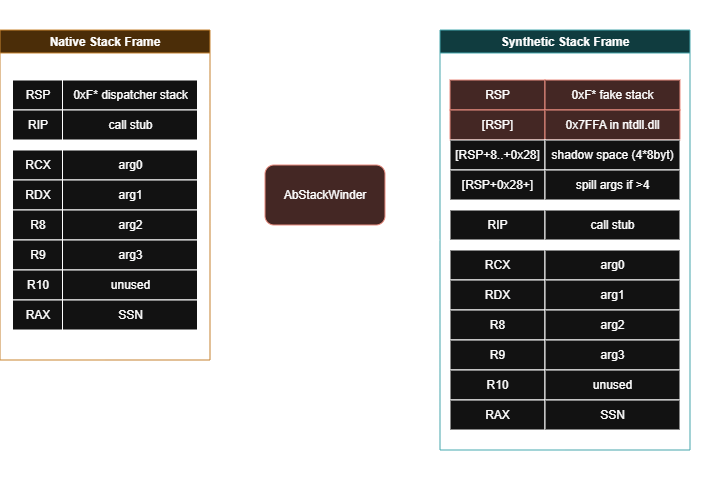
As a result, the immediate return context reflects a legitimate ntdll!Nt* export stub rather than a private executable region.
The objective is not to fabricate arbitrary call chains or emulate higher-level API transitions. The design is intentionally minimal: only the top-of-stack return address is aligned with the corresponding ntdll export, preserving calling convention correctness while avoiding obvious private-memory return targets.
Because only the dispatcher thread executes syscall stubs, stack layout remains controlled and predictable. Callers populate a flat ABOpFrame structure and signal execution via an atomic state transition. No caller stack frames participate in stub invocation.
ABE has two execution models, "direct syscalls" & "indirect syscalls", both have their strengths & tradeoffs.
A direct syscall is a sure secure way for ABE to dispatch your syscall. This will always work no matter the EDR instrumentation, API hooks in ntdll.dll or even so far as ntdll.dll having it's System Call Stubs overwritten/corrupted. This is because ABE manages the stub-system & lifecycles + encryption & data management.
This comes with the trade-off of exposing some RWX memory for heuristics to possibly flag.
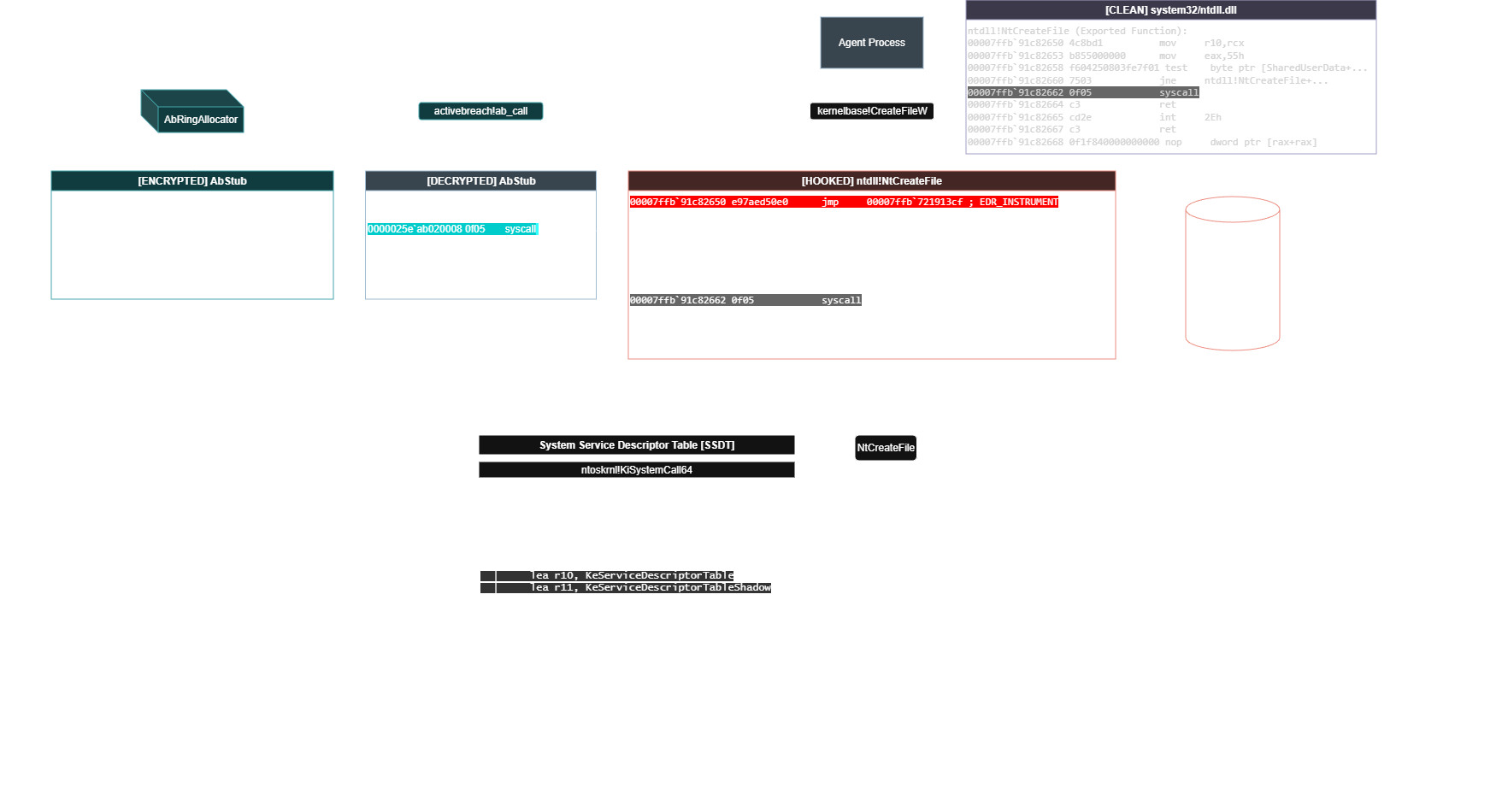
ABE's way of executing indirect-syscalls is leveraging the already existing System Call Stubs inside of ntdll.dll, but running prior hook-scanning logic to detect & mitigate hooks that may be present. This is by nature more stealthy & creates a more native stack-frame, though isn't unbreakable as a corrupted/overwrriten stub will cause the ABE not to be able to execute the syscall.
This comes with the trade-off of the system breaking if ntdll.dll is tampered with, and no control over stubs.
The dispatcher thread uses an ABOpFrame as a shared control block to coordinate syscall execution with caller threads.
The ABOpFrame acts as a minimal, flat command packet rather than a call stack or queue. Callers populate the frame with the resolved syscall identifier and arguments, then signal the dispatcher via an atomic state transition. The dispatcher is the only thread permitted to execute syscall stubs; callers never invoke syscalls directly. This prevents stack pollution and allows future indirection/synthetic calls.
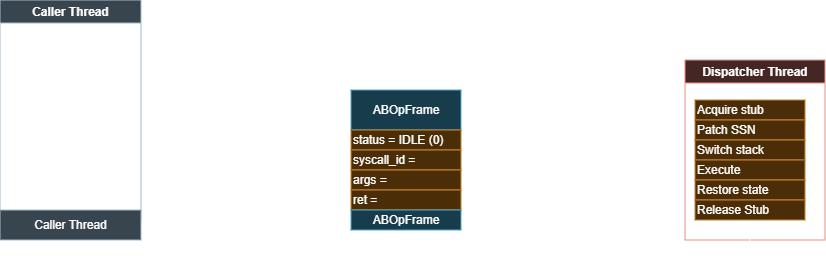
Synchronization is intentionally coarse and explicit. A single atomic status field serves both as a state machine and as the memory-ordering boundary between threads. Callers publish requests using a store(Release), while the dispatcher observes and consumes them using load(Acquire). This establishes a strict happens-before relationship, ensuring that argument data and return values are fully visible without requiring locks or per-field atomics.
ABE deliberately serializes syscall execution.
Rather than distributing stub execution across multiple threads, a single dispatcher thread processes requests through a shared control block (ABOpFrame). Callers publish arguments and block until completion.
This has several implications:
While this limits raw throughput compared to per-thread stub invocation, it reduces behavioral dispersion. Many detection models rely on correlating distributed execution sites or observing anomalous concurrency patterns. ABE instead consolidates syscall transitions into a single long-lived execution context.
The concurrency model is therefore a surface-area trade-off rather than a performance optimization.
ABE does not assume perpetual execution.
The dispatcher supports an idle timeout mechanism under which internal resources are released after a sustained period of inactivity. When triggered, the stub pool is torn down and the syscall table can be deinitialized. Memory regions are wiped prior to release.
This allows the engine to reduce its footprint during dormant phases rather than maintaining persistent executable pools indefinitely.
Stub slots are always rewritten and re-encrypted upon release, and in secure mode are transitioned to NO_ACCESS when idle. Allocations are pooled and reused to avoid repeated allocation churn.
The lifecycle model favors amortized allocation, explicit teardown, and bounded exposure windows over continuous residency.
ABE provides a single simple function, ab_call
pub unsafe fn ab_call(name: &str, args: &[usize]) -> usize {
    if name.len() >= 64 { // Syscall len check
        return ABErr(ABError::DispatchNameTooLong) as usize;
    }

    if args.len() > 16 { // Syscall argument count check
        return ABErr(ABError::DispatchArgTooMany) as usize;
    } // No Syscall has 16+ arguments

    while !G_READY.load(std::sync::atomic::Ordering::Acquire) {
        let zero: u8 = 0; // Wait for ABE ready signal

        let ready_ptr: *const std::sync::atomic::AtomicBool =
            &G_READY as *const std::sync::atomic::AtomicBool;
        let zero_ptr: *const u8 = &zero as *const u8;

        let _ = WaitOnAddress(
            ready_ptr as *const c_void,
            zero_ptr as *const c_void,
            std::mem::size_of::<u8>(),
            Some(INFINITE),
        );
    }

    __ActiveBreachFire(name, args) // provide SSN & arguments
}
Intended to be versatile, ab_call allows you to invoke any Nt* syscall.
It's used like this;
use activebreach::ab_call; // import ABE
use windows::Win32::System::Memory::{
    MEM_COMMIT, MEM_RESERVE, PAGE_READWRITE, // page protection flags
};

unsafe {
    let mut base_address: *mut core::ffi::c_void = core::ptr::null_mut();
    let mut region_size: usize = 0x1000;

    // status contains the NTSTATUS returned by the syscall
    let status = ab_call(
        "NtAllocateVirtualMemory", // name of Nt* syscall
        &[
            windows::Win32::System::Threading::GetCurrentProcess().0 as usize,
            &mut base_address as *mut _ as usize,
            0,
            &mut region_size as *mut _ as usize,
            MEM_COMMIT | MEM_RESERVE, PAGE_READWRITE,
        ],
    );

    if status != 0 { // 0 = SUCCESS, if NOT success then print the failure code from NTSTATUS
        panic!("NtAllocateVirtualMemory failed: {:#x}", status);
    }
}
Within ABE, syscall stubs exist in decrypted form only during a narrow execution window. Exposure is limited to the interval between stub acquisition and release, illustrated below:
callq  0x7ff6952da630             ; AbRingAllocator::acquire() stub.rs:128
testq  %rdx, %rdx
setne  %cl
testb  %cl, %al
je     0x7ff6952cf8cd             ; <+2013> at lib.rs:156
movq   %rdx, %rbx
testb  $0xf, %bl
je     0x7ff6952cfa8e             ; <+2462> at lib.rs:156
leaq   0x57822(%rip), %rcx        ; G_STUB_POOL
callq  0x7ff6952d7460             ; deref AbRingAllocator
movq   %rax, %rcx
movq   %rbx, %rdx
callq  0x7ff6952da710             ; AbRingAllocator release(*mut u8) stub.rs:172
With over 50 samples, averaged out to 13.9µs of exposure (4.6ghz 24H2).
Stealth: best when transition noise is heavily scored. Upside is fewer VirtualProtect transition signals; cost is persistent RWX presence being easier to flag heuristically.Secure: best when process-protection is necessary, secures ABE's data & protects the stubs with page flips, more noisy to the kernel.NTDLL Backend: best when max-stealth is necssary, uses a different dispatcher architecture which routes syscalls the native way via ntdll.dll, but checks for hooks & sidesteps API's.In practice, mode choice should be driven by the purpose of the operation.
Once constructed, the internal syscall table is treated as immutable metadata.
During initialization, a hash of the table contents is computed and stored. Prior to dispatch, the table hash is verified to ensure that the mapping between syscall names and SSNs has not been altered.
In secure configurations, integrity mismatches result in termination.
The table itself resides in a dedicated page transitioned to READONLY after init. Dispatch code never modifies table entries after this point.
In addition to structural surface reduction, ABE includes lightweight runtime validation checks designed to detect anomalous execution environments.
These include:
BeingDebugged flag within the PEBIn secure configurations, certain violations can trigger immediate termination. In non-secure builds, violations are logged or surfaced via callback.
| Signal / Technique | Typical Detection | ABE Posture | Residual Risk |
|---|---|---|---|
Plaintext syscall opcodes |
Binary scanning, smart-screen | Eliminated via build-time encryption | None |
| Canonical syscall prologues | Signature-based rules | Eliminated (no static stubs) | None |
| Executable code in unusual sections | Heuristic static analysis | Not present | None |
| Known stub templates | Hash/signature matching | Not present | None |
| Signal / Technique | Typical Detection | ABE Posture | Residual Risk |
|---|---|---|---|
syscall outside ntdll |
Memory scanning | Transient only | Microsecond window |
| Long-lived executable stubs | Periodic memory sweeps | Avoided via pooling + rewrite | Low |
| Private RWX regions | Heuristic flags | Configurable (feature modes) | Context-dependent |
| Pattern-matched stub layouts | In-memory YARA | Obfuscated + ephemeral | Low |
| Signal / Technique | Typical Detection | ABE Posture | Trade-off |
|---|---|---|---|
VirtualProtect transitions |
Kernel telemetry / correlation | Optional (secure mode) | Kernel noise |
| Stable RWX regions | Heuristic detection | Optional (stealth mode) | Memory exposure |
| Widespread page flipping | Correlation analysis | Avoided (localized pool) | None |
| Exec permission churn | Behavioral heuristics | Bounded & centralized | Acceptable |
| Signal / Technique | Typical Detection | ABE Posture | Residual Risk |
|---|---|---|---|
| User-mode API hooks | EDR instrumentation | Eliminated | None |
ntdll entrypoint hooks |
Inline detours | Eliminated | None |
| Per-call inline execution | Call-stack inspection | Eliminated | None |
| Distributed execution sites | Surface expansion | Centralized | None |
| Signal / Technique | Typical Detection | ABE Posture | Residual Risk |
|---|---|---|---|
| Anomalous call stacks | Stack walking | Controlled / synthetic | Low |
| Inconsistent TEB state | Context checks | Monitored | Low |
| High syscall fan-out | Behavioral models | Serialized | Throughput-limited |
| Reentrancy anomalies | Runtime faults | Disallowed by design | None |
For the Secure mode specifically, tamper resistance is structured around execution gating and integrity checks:
| Control | Implementation | Effect on tampering risk |
|---|---|---|
| Stub page state at rest | Syscall stubs are set to NO_ACCESS when idle |
Lowers passive read/write opportunities against stub memory |
| Stub exposure window | Stubs are only materialized for execution windows, then returned to protected state | Narrows practical patch/tamper timing windows |
| Stub-at-rest protection | Stub material is encrypted at rest (applies to both Stealth and Secure) |
Reduces value of memory snapshots when stubs are not active |
| Dispatch metadata integrity | SYSCALL_TABLE is READONLY and hash-checked during __ActiveBreachFire |
Raises difficulty of SSN/dispatch tampering |
| Runtime anti-debug checks | IsDebuggerPresent, TEB debugger-flag checks, and timing checks around syscall paths |
Increases cost of interactive instrumentation and timing-assisted manipulation |
Operationally, this puts syscall stub tampering in the low-probability bucket for user-mode-only interference, while still acknowledging that kernel-observable behavior and active kernel enforcement remain out of scope.
To make the boundary explicit: ABE reduces user-mode call-path observability, but it does not remove kernel visibility. These kernel callback surfaces still apply:
| Kernel callback / heuristic surface | Why it matters for ABE | What ABE changes | Residual exposure |
|---|---|---|---|
PsSetCreateThreadNotifyRoutine / PsSetCreateThreadNotifyRoutineEx |
Dispatcher thread creation and termination are kernel-visible events | ABE centralizes syscall execution into a single long-lived dispatcher thread instead of spawning many short-lived worker threads | Dispatcher lifecycle and scheduling remain visible |
PsSetLoadImageNotifyRoutine |
Image mapping and module loads are observable | ABE avoids embedding static syscall stubs or auxiliary helper DLLs | Legitimate image mapping activity remains observable |
NtAllocateVirtualMemory |
Executable or private memory allocation can be correlated with behavior | Allocations are pooled, reused, and amortized rather than performed per syscall | Initial allocation remains visible |
NtProtectVirtualMemory |
Page protection changes are a common behavioral signal | Protection transitions are localized to a small stub pool and are optional (feature modes) | In secure mode, protection flips remain observable |
Syscall origin validation (RIP outside ntdll.dll) |
Some kernel telemetry validates that syscall transitions originate from ntdll.dll |
Stub backend executes from private memory; NTDLL Backend routes via verified ntdll.dll!Nt* exports |
Stub backend may appear anomalous; NTDLL Backend preserves canonical module-origin semantics |
With those boundaries established, ABE exists to replace brittle, ad-hoc syscall techniques with a cohesive execution model that remains usable and predictable under modern defensive scrutiny.
Red-team's have long needed a tool for dealing with API hooking that is secure, stable & configurable, that is the goal of Activebreach.
ABE was handcrafted for performing exactly that, a controlled execution model, which was stable and integrateable enough without having the detection surface of similar tooling.
If you're interested, I would highly reccomend reading the code at;